
Ten apartments appear in the listing, but the review file supports only nine. Which count belongs in the acquisition model? Use the configuration supported by reconciled records and qualified local review. In the hypothetical example that follows, separate the tenth apartment’s rent from the base case while retaining its expenses and resident obligations.
The tenth apartment is occupied and collecting rent. That makes the uncertainty harder to dismiss and more important to handle carefully. For accredited investors considering Southern California multifamily, the question is whether the purchase still works before the missing evidence arrives. A spreadsheet adjustment cannot decide a dwelling’s legal status or a resident’s rights.
Find the tenth apartment in the records
A listing describes what is being marketed. A rent roll describes rental arrangements. Neither, by itself, establishes the approved configuration of a building. An assessor entry, permit record, occupancy document and physical inspection can each contribute evidence, but they should not be treated as interchangeable.
Ask the sponsor to prepare a reconciliation schedule with one row for each separately rented or advertised dwelling. Include its current label, location, lease reference, collected rent, corresponding plan label, permit references and unresolved questions. Keep copies of the underlying documents rather than relying on a spreadsheet’s conclusion.
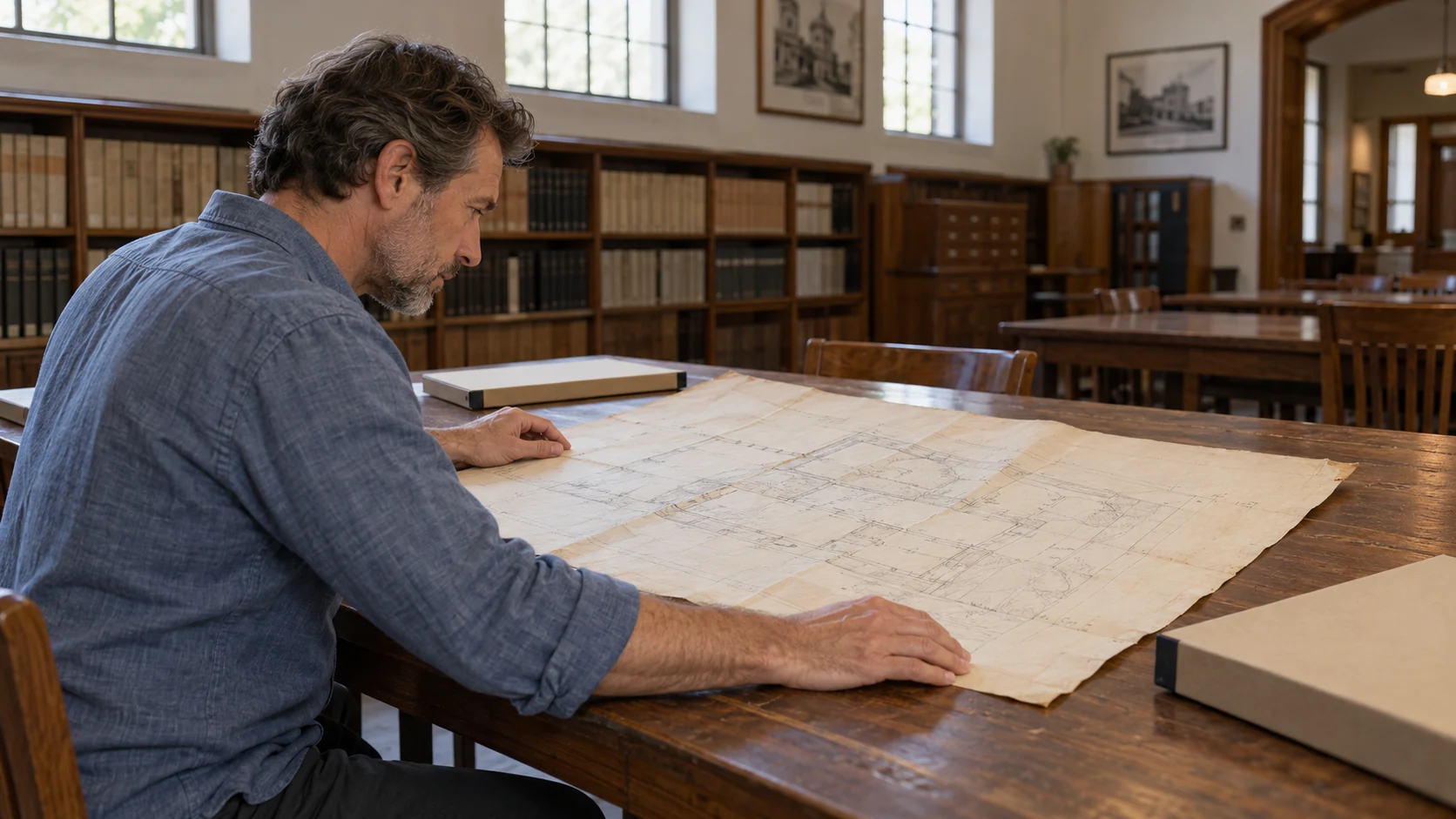
Before treating the tenth apartment as a conversion, match its address and location to the older plans. A rear dwelling may use a different street number; a drawing may use letters instead of today’s unit labels. A numbering change would call for reconciliation, while an unexplained configuration would call for further professional review.
This is narrower than the broader document review used to compare multifamily properties: the question here is whether every income-producing space can be traced to records supporting the use assumed in the acquisition model.
Read each record for what it actually establishes
The strongest review connects documents across time. An original building plan may explain the initial arrangement but not a later conversion. A later permit may authorize limited work without resolving whether the entire space was approved as a separate dwelling.
- Listing and seller materials: identify the claimed count and request the documents behind any statement about additional apartments.
- Assessor records: compare reported characteristics and flag differences for investigation; do not treat the entry alone as permission for the present use.
- Permit files and approved plans: examine the work description, affected location, revisions and available inspection or completion records.
- Occupancy records: request certificates or other applicable records where available, and have a qualified reviewer explain their scope and relationship to later changes.
- Observed layout: compare kitchens, bathrooms, entrances, partitions and connections between spaces with the drawings, using appropriately arranged access.
A separate utility meter, mailbox or longstanding lease can help identify how a space operates. It does not substitute for the approval history. Conversely, a missing online result does not establish that a dwelling was never approved.
Search the right jurisdiction and archive
Identify the agency responsible for the property’s building records rather than relying on its mailing address. The City of San Diego’s records guidance illustrates why search scope matters: it provides online research routes for permits and applications from 2003 onward, directs customers to appointments for archived building records after 1955, and refers inquiries about buildings predating 1955 to the County Assessor’s Office.
The city also cautions that not all record types may be available because procedures and legal requirements have changed. Its self-service option does not provide access to building plans; those requests require an in-person appointment with staff. These are City of San Diego procedures, not a records-search protocol for every Southern California municipality.
For the unresolved tenth apartment, preserve the search trail: addresses checked, systems searched, files requested and agency replies. A pending archive appointment is different from a completed search that found no supporting record. Ask a local architect or permit specialist what additional evidence could settle the discrepancy, with land-use counsel addressing interpretation.
Let the unresolved apartment change the model
A reconciliation schedule should lead to an underwriting decision, not merely a larger document folder. Separate spaces with supporting records and completed professional review from those awaiting records or presenting a conflict. These are diligence categories, not legal classifications.
For the unresolved space, show historical collections separately from revenue credited in the base acquisition case. Excluding that revenue for investment analysis does not instruct the owner to stop collecting rent, terminate a lease or alter services. Those operating decisions require their own legal review.
Do not remove the associated expenses automatically. Maintenance, utilities, safety work and professional fees may continue. The model may also need a separate allowance for investigation, corrective work or resident-related obligations, based on qualified estimates rather than an assumed inexpensive approval process.
Hypothetical example: one unresolved apartment
Assume a property is advertised as ten apartments. For this illustration, local reviewers have supported the present use of nine, while the tenth cannot yet be matched to sufficient approval records. Each supported apartment rents for $2,200 per month; the unresolved apartment rents for $1,800.
Assuming full collection for twelve months, with no vacancy, concessions or other income, the advertised rent total is $259,200 annually: nine times $2,200 times twelve, plus $1,800 times twelve. Excluding the unresolved apartment produces $237,600, a reduction of $21,600.
If annual operating expenses remain $100,000 in both cases, illustrative net operating income falls from $159,200 to $137,600. These figures are before debt service, capital improvements and any additional discrepancy-related costs. They are arithmetic assumptions, not market estimates or an actual VisionWise Capital transaction.
At $137,600 of illustrative NOI, the purchase must stand on a different income case from the listing. That is the decision the missing file creates. Add supported investigation and corrective-work estimates separately; if the return only becomes acceptable after restoring the tenth apartment’s rent, the investment still depends on an unresolved outcome.
An occupied space is not just a records problem
A mismatch can involve someone’s home. Do not assume uncertain approval records eliminate tenant protections or create an immediate path to vacant possession. The California Attorney General’s landlord-tenant guidance describes habitability duties, eviction protections and the need to consider additional local rules. It does not determine the status of a particular apartment.
Have counsel familiar with the jurisdiction evaluate the actual tenancy, any agency notices and the proposed response. Have appropriate building professionals assess safety concerns promptly. A conservative income assumption is not a substitute for addressing an unsafe condition.
The wider interaction between operating plans and tenant protections is addressed in how local regulation changes multifamily underwriting. Here, the immediate question is whether the proposed response to the count discrepancy has a documented, property-specific basis.
Similarly, calling a converted space an accessory dwelling unit does not resolve its history. The investment considerations for an accessory dwelling unit are relevant context, but possible future approval should remain separate from evidence supporting today’s configuration.
Set a decision threshold before the deadline
As the review deadline approaches, return to the tenth apartment rather than the advertised count. Ask for a written disposition identifying the evidence received, responsible professionals, remaining questions and assumptions allowed in the model. A seller’s explanation can direct the search, but the investor needs to know what would actually change the current assessment.
- Which specific space remains unresolved, and what document or professional conclusion would change that assessment?
- Does the model exclude its rent while retaining realistic expenses and additional review costs?
- Have the lender and insurance broker received the same description of the discrepancy, and what further review do they require?
- Is any proposed corrective work supported by a defined scope, qualified cost estimate and realistic approval sequence?
- What happens if the records remain incomplete when the purchase decision is due?
Red flags include a permit number without the underlying file, drawings that do not match the rented configuration, or assurances that years of collections settle the question. Another is a model that removes uncertain rent during diligence but quietly restores it in the resale assumptions.
The decision may be to seek more time, revise the economics, establish a professionally reviewed resolution condition or decline the opportunity. A lower price alone does not resolve safety issues, resident obligations or uncertainty about continued use.
To discuss how an unresolved unit count should shape your questions about a proposed investment, Schedule a consultation.
Important information
Past performance is no guarantee of future results. All investments involve risk and may result in loss. This material is for informational purposes only and does not constitute an offer to sell securities or a solicitation of an offer to buy securities.
Property-specific conclusions about approved use, building safety and resident obligations require current review by qualified local building professionals and legal counsel.