
Twenty-two occupied apartments. Twenty-four in the building. In this hypothetical monthly review, the occupancy headline looks reassuring, but current-month rent paid is only $48,000 against $60,000 of potential rent. What explains the gap? Follow the leases, concessions and payment allocations through a monthly income bridge before accepting the headline as evidence of stronger cash flow.
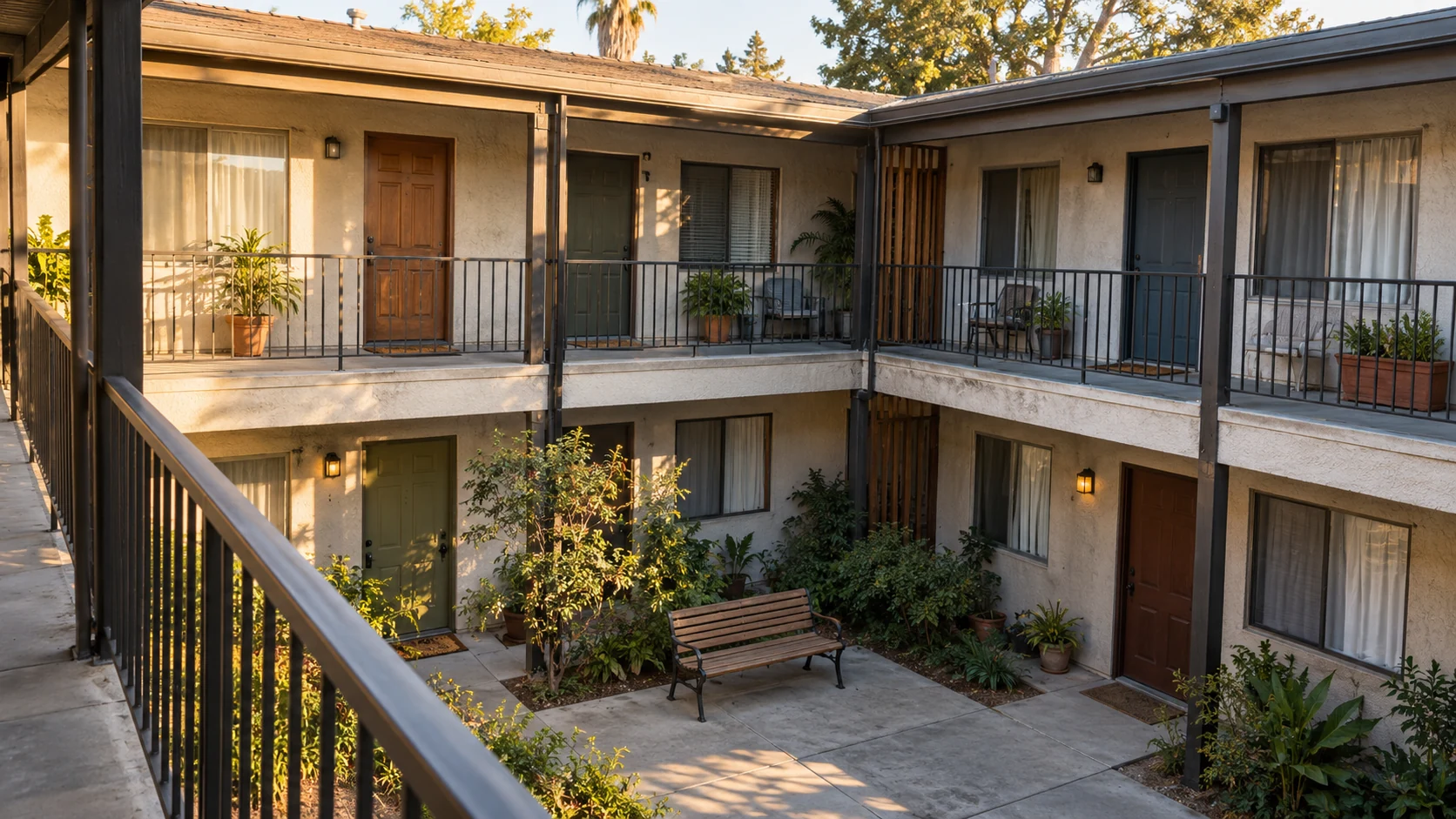
The unit count is accurate. That is what makes the decision interesting. Nothing needs to be falsified for a report to encourage the wrong conclusion; an accurate answer to one question can be mistaken for an answer to another. Physical occupancy describes occupied units. It does not establish how much rent those units produced.
This invented 24-unit property is not a VisionWise Capital transaction. Its simplified records let accredited investors follow a decision from a reassuring percentage to the evidence needed for an income assumption. All amounts are illustrative, not Southern California market benchmarks.
Start with the number the report gets right
Assume a 30-day month with 22 units occupied throughout and two vacant throughout. There are no midmonth moves or offline renovation units. Physical occupancy is 22 divided by 24, or 91.67%. Because status never changes, occupied unit-days divided by total unit-days produces the same result.
At a real property, that second calculation can matter. A month-end snapshot might show an apartment occupied even though it was vacant earlier. Ask which units remain in the inventory and whether a signed lease without possession counts as occupied. Establish the definition before comparing reports.
The OCC’s Commercial Real Estate Lending handbook tells bank reviewers examining multifamily property to consider actual collections rather than rely on high occupancy shown by a rent roll. It supports checking the money behind the percentage, without prescribing the particular calculation used in this example.
Our investor’s decision is whether the leasing result supports a higher forward-income assumption. Before making that change, the investor needs to find out what sits between occupied apartments and rent paid.
Follow the missing dollars, one adjustment at a time
Give every unit an assumed reference rent of $2,500 per month. Full-occupancy potential is therefore $60,000: 24 multiplied by $2,500. This reference is a comparison benchmark, not a claim that all existing leases can immediately reach that rent.
The two vacant apartments remove $5,000, leaving $55,000 of reference rent for occupied units. Their actual leases total $52,800 before concessions. That $2,200 difference belongs to the occupied leases; subtracting it from vacant units as well would count a shortfall twice.
Next come $1,800 of current-month concessions. Net current-month charges are now $51,000. Of those charges, $3,000 remains unpaid at month-end, leaving $48,000 of current-month rent paid. Assume no earlier prepayments were applied, no payment reversals occurred and all receipts cleared within the month.
The gap has become specific: $5,000 of vacancy, $2,200 of lease-rate shortfall, $1,800 of concessions and $3,000 unpaid. Together they explain the $12,000 difference between potential rent and current-month rent paid. Those are four different operating questions, with different possible remedies and limitations.
Our defined economic occupancy measure is $48,000 divided by $60,000, or 80.00%. Management may use recognized revenue or a different rent benchmark. Request its definition and reconciliation rather than assuming another convention is wrong. The rent-roll reconciliation review provides the document checks behind these amounts.
The bank deposit offers another tempting answer
Now suppose the rental cash receipts report shows $50,000. That does not invalidate the $48,000 calculation. The property also collected $1,200 of earlier arrears and $800 of next month’s rent. Those receipts explain the additional $2,000, but neither is payment for this month’s charges.
Recovering overdue rent helps cash. Receiving rent early also changes the bank balance. Neither establishes that current-period leasing produced an extra $2,000 of recurring income. Using $50,000 as this example’s current-month numerator would blur the improvement the investor is trying to measure.
There is a third plausible percentage: $48,000 divided by $51,000, or 94.12%. It measures payment against net current-month charges. It excludes vacancy, the lease-rate difference and concessions from its denominator. All three percentages can be calculated correctly while answering different questions.
A strong collection percentage cannot explain an income gap until the denominator is visible.
Keep the month-end cutoff and report preparation date on the page. A payment arriving later can demonstrate recovery without silently changing the original result. If a prior period is restated, preserve the explanation and comparable history. The investor needs to distinguish a recovery from a revised measurement.
The decision changes when the gap has a name
Return to the proposed income increase. Filling the two vacant apartments would address one line of the bridge. It would not, by itself, remove concessions, cure unpaid balances or change existing contractual rents. A forward model that assumes all four improve needs evidence for all four.
If downtime comes from repairs, connect the missing rent to the work schedule. The discussion of vacancy, rents and repairs in Orange County explains that operating connection. Signing a lease before work is finished does not make its rent available on the original assumed date.
The cautious choice carries a cost too. Keeping a lower income assumption may make an opportunity look less attractive or leave less room for distributions. But raising the forecast before the evidence improves would move uncertainty into the cash plan. Southern California lease terms and applicable rental requirements also limit what can be assumed about moving existing rents toward a reference level; obtain property-specific legal advice.
Watch for apparent improvement caused by removing offline apartments from the inventory, changing reference rents without explanation or including arrears recoveries as current-period performance. A ratio can rise without the property collecting more on the same basis.
What to bring to the next review
For a VWC investment discussion, bring the unresolved income assumptions and ask for the relevant reporting definitions. This hypothetical does not describe VWC’s actual collections or promise a particular reporting package. The governing documents and property records establish what is available.
- Which adjustment explains the largest gap, and what record supports it?
- How much of this month’s receipts belongs to earlier or later charges?
- What evidence supports the improvement assumed for each line next month?
- What does the cash plan look like if that improvement is delayed?
A usable reconciliation connects unit-status history, lease charges, concessions, payment allocations, receivables and bank activity. Keep security deposits, owner contributions and account transfers separate from rental income. If unpaid rent already reduced a payment-based measure, an accounting write-off should not reduce it again.
The exercise ends with a more useful conclusion than “occupancy is high.” Twenty-two apartments are occupied, $48,000 pays this month’s rent, and the remaining differences require separate decisions. Expenses, capital work, debt payments and reserves still stand between rental income and distributions. Review property income and operating costs before making that final step.
To place these questions within the broader acquisition and operating review, Learn more about the VisionWise investment process.
Important information
Past performance is no guarantee of future results. All investments involve risk and may result in loss. This material is for informational purposes only and does not constitute an offer to sell securities or a solicitation of an offer to buy securities.