
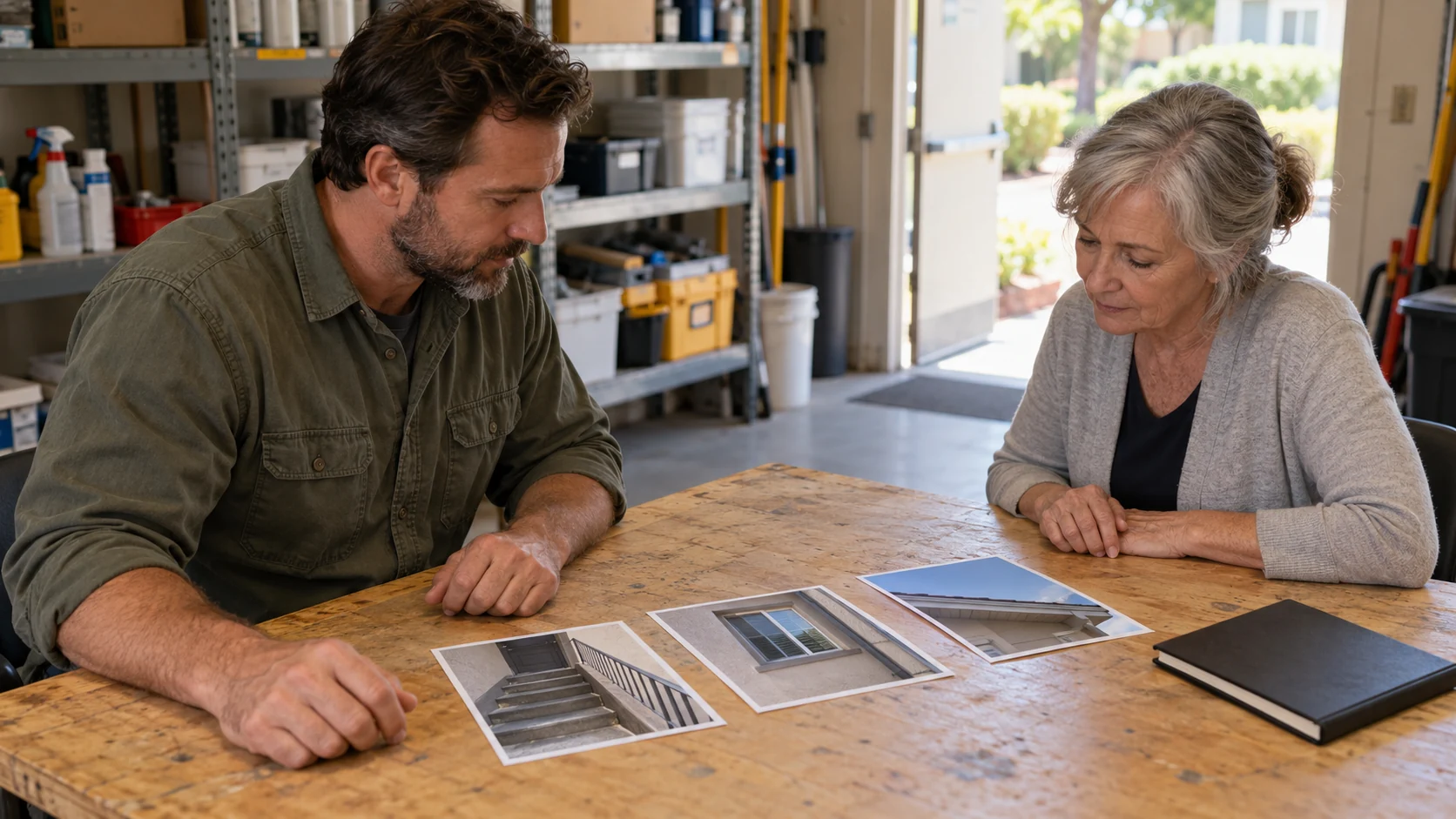
Which observations from an apartment walkthrough should change the acquisition budget, and which still need investigation? A multifamily walkthrough tests whether the rent roll, maintenance spending, and capital plan describe the building accurately. It can reveal issues that warrant specialist investigation, but visual access alone cannot establish every system’s condition. Accredited investors should ask which observations changed the model and which uncertainties remain unresolved before relying on a pro forma.
A stain is an observation. The cause, repair scope, and cost still need evidence before they belong in the model.
Start with the differences between the records and the building
A pro forma is built from reported numbers — rent roll, trailing expenses, a capex schedule someone wrote down. A walkthrough tests whether those numbers match what the building is actually doing. Water staining near a roofline that doesn’t appear in the capex plan. A maintenance log full of repeat work orders for the same unit, suggesting a root cause nobody fixed. A common-area safety issue that would trigger a cost, and possibly a regulatory notice, that the pro forma never priced.
| What the spreadsheet shows | What a walkthrough can reveal |
|---|---|
| Capex line: roof, year 8 | Visible membrane wear requiring a roofing specialist to assess condition and timing |
| Maintenance expense: stable trailing 12 months | A backlog of repeat work orders masked by low total spend |
| Unit mix: standard 1BR/2BR | Layout differences requiring comparison with plans, permits, and records |
| Vacancy: in line with market | Units held offline for repairs not reflected in the vacancy line |
Quick definition: what is a work-order backlog?
A work-order backlog is the set of maintenance requests still unresolved. Age, urgency, repeat visits, and reasons for delay matter more than the count alone. The response may involve routine repairs, specialist investigation, or capital work. A backlog does not by itself establish the cause, accounting treatment, or eventual cost.
How Could a Walkthrough Change the Capital Plan?
In a hypothetical Southern California property with fewer than 50 units and acquisition leverage below 50% loan-to-value, several apartments show repeat plumbing complaints while total maintenance spending appears stable. That pattern could justify a specialist investigation of shared lines. It does not establish a diagnosis or a repair price. Obtain an assessment, define the scope, and revise the cash plan using supported estimates. The illustration makes no claim about an actual VWC property or a completed repair.
Quick definition: how does a formal Property Condition Assessment differ from a walkthrough?
A PCA follows an agreed scope, often using ASTM E2018 as a baseline guide. It combines observations, available records, and inquiries with reported deficiencies and cost opinions within that scope. Estimates of remaining useful life are judgments, not warranties. Read the exclusions and recommendations for additional investigation.
Which Walkthrough Findings Should Change the Underwriting?
Treat the walkthrough as an input to the model. Record recurring complaints, visible wear, and layout discrepancies, then identify what additional evidence each requires. Compare suspected alterations with permit records before calling them unpermitted. Revise expense or capital assumptions when the scope and timing are supported, and keep unresolved items visible. A model should show where an estimate remains uncertain rather than presenting every observation as a confirmed defect.
The sharpest questions are specific: what does the work-order log show over the trailing twelve to twenty-four months, not just the current snapshot? Are any units held offline, and is that reflected in the vacancy figure? What did the inspector flag that isn’t in the seller’s summary of the inspection?
Who Should Be in the Room for the Walkthrough?
Match the team to the building and the questions being investigated. A qualified property-condition consultant can coordinate the assessment; licensed engineers, roofing specialists, electricians, or other professionals may be needed for particular systems. ASTM E2018 is an assessment guide, not a professional license. Check relevant qualifications, independence, scope, and insurance. A property manager adds operational context but does not replace specialists where technical investigation is needed.
What Should Be Recorded During the Inspection?
Give each material observation a location, date, photograph where appropriate, and an explanation of its significance. Separate what was seen from what is suspected. Water staining is an observation; an active roof leak is a possible diagnosis that requires investigation. The distinction prevents an uncertain visual clue from becoming an unsupported cost estimate in the acquisition model.
Record inaccessible areas and sampling limits. If only some apartments were entered, identify the selection method and whether vacant, renovated, and occupied units were represented. A clean sample does not prove every unit has the same condition. Residents’ privacy, lawful access, notice, and safety requirements must govern the visit; urgency around a transaction is not a reason to disregard them.
How Do Work Orders Connect to the Budget?
Ask for opening and closing dates, issue categories, repeat visits, and evidence that the underlying problem was resolved. A ticket marked complete might record a temporary repair rather than replacement of a failing component. Compare recurring complaints with invoices, vendor recommendations, and any existing warranty. Missing records are a limitation to disclose, not proof that no problem exists.
Translate a confirmed issue into scope, timing, and cash consequences. Does the repair require access to occupied units, permits, specialist design, temporary protection, or further investigation? Who priced those elements and when? Check whether the proposed cost is already included elsewhere in the capital plan to avoid double counting. If no reliable estimate exists, identify the unresolved allowance and the work needed to narrow it. The capital-expenditure plan review extends that check to the overall budget and reserves.
Life-safety or habitability concerns require appropriate professional attention; they should not be treated as discretionary improvements that can simply be deferred to preserve distributions. Conversely, a cosmetic issue should not automatically become evidence of structural failure. The investor’s job is to ask how the qualified reviewers distinguished those categories and how their conclusions affected the plan.
The ASTM E2018 baseline guide sets out an assessment framework with limitations. A general assessment does not automatically include invasive testing, environmental investigation, or a complete code-compliance certification. Confirm any additional scope before relying on the report for a question it was not commissioned to answer.
Connecting the property visit to the operating decision
This is the same filter behind the VisionWise Way: direct attention to property operations, not just the financial model built on top of them. A disciplined underwrite treats the physical building as a primary source of evidence, not a formality to clear before closing.
What Risks Remain Even After a Thorough Walkthrough?
A building assessment leaves market, financing, operating, sponsor, regulatory, tax, and liquidity risks to evaluate separately. A scoped inspection can identify conditions requiring attention, but inaccessible systems, sampling limits, and latent defects leave uncertainty. Conditions can also change after closing. Inspection findings inform a decision; they do not certify that the building is free of problems or ensure the investment will perform.
What Should I Ask Before Trusting the Pro Forma Over the Building?
- What does the maintenance work-order log show over the trailing 12–24 months?
- Are any units held offline, and is that reflected in the reported vacancy?
- Was a formal PCA performed, and what did it flag that the summary doesn’t mention?
- Which capex or expense line items were revised after the walkthrough, if any?
- Has a qualified inspector or property-condition professional reviewed the findings, not just the summary?
Learn more about the VisionWise investment process. Use its operating focus to frame the evidence questions raised by a property visit.
The accredited-investor resource explains eligibility for private offerings. Physical diligence remains a separate task that requires appropriate access, records, and qualified reviewers.
Important information
Past performance is no guarantee of future results. All investments involve risk and may result in loss. This material is for informational purposes only and does not constitute an offer to sell securities or a solicitation of an offer to buy securities. Accredited investors should review the governing documents with their own legal, financial, and tax advisors and obtain qualified technical advice on material inspection questions.
Assessment reference: ASTM E2018-24, Standard Guide for Property Condition Assessments, which describes the baseline inquiry. Actual findings require property access, records, qualified assessment, and any necessary specialist investigation; the plumbing example is hypothetical.