
The presentation says the apartment property breaks even at 75% of rental potential. That sounds like room for error. Should an investor rely on it? Only after rebuilding the cash requirements and testing what changes under stress. In this hypothetical review, higher expenses and debt payments move the threshold to 87%, changing the decision without changing a single apartment.
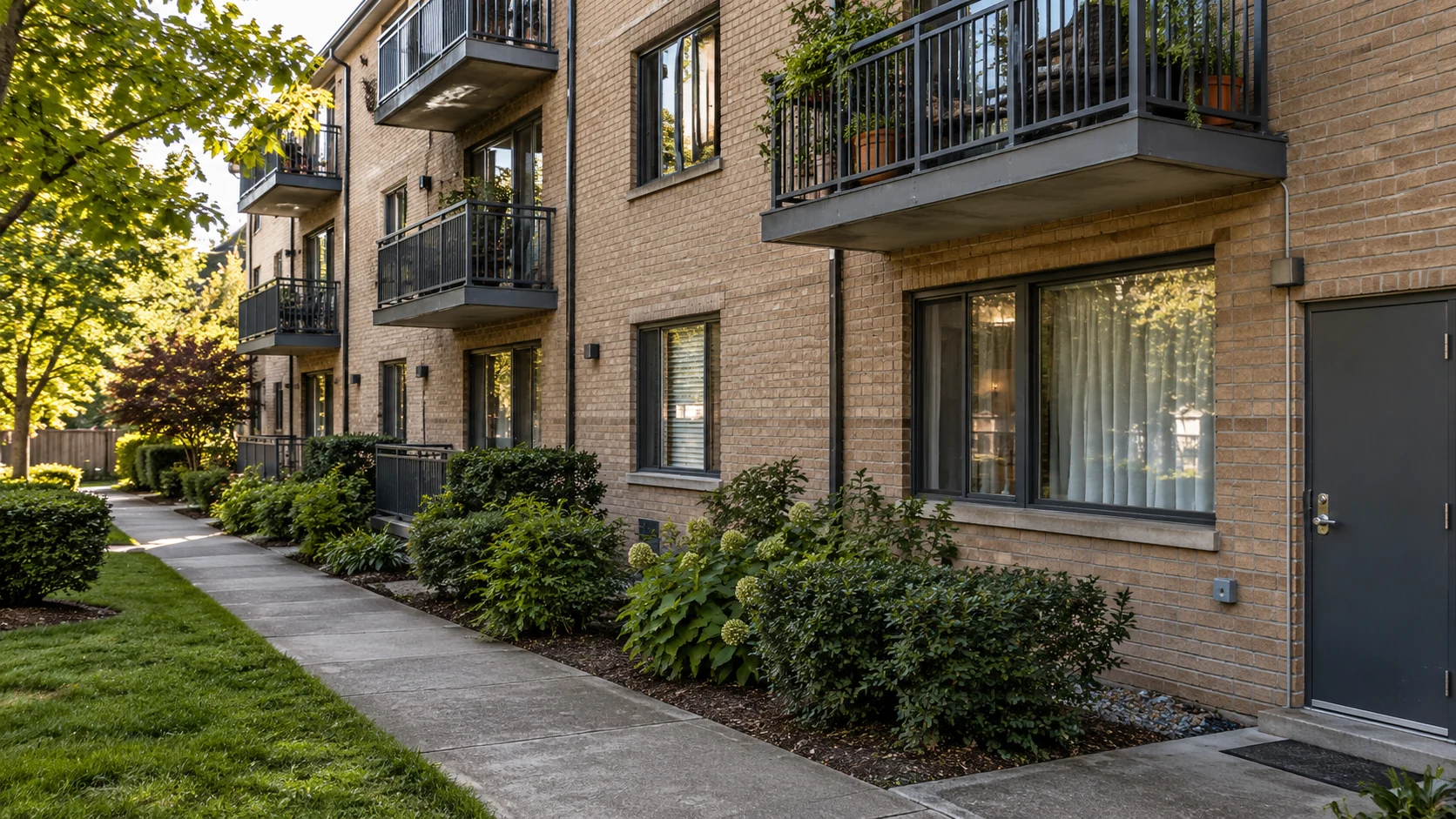
Imagine an accredited investor studying a 20-apartment Southern California acquisition. The first question is about vacancy; the important discovery will concern the costs that remain when collections weaken. This is a fictional decision exercise, not a VWC transaction. Its tension comes from a defensible calculation being asked to support a broader conclusion than it can carry.
The first percentage answers the wrong question
Physical occupancy measures occupied apartments. A cash break-even test measures dollars received against specified cash requirements. Those are different measurements, even when a presentation labels both as occupancy.
Begin with the building in the example: 20 equally priced apartments at $2,500 a month, giving $50,000 of full monthly rental potential. Eighteen are occupied, or 90%. Yet current rent received is $42,000 after concessions and unpaid balances: 84% of potential. The investor has already encountered two plausible percentages describing different things.
For this article, the collection ratio means rental cash received divided by rental potential at full occupancy using the model’s stated rents. The denominator includes every apartment, including vacant units; it does not assume future renovation premiums. The ratio captures vacancy, concessions, and collection losses together. Those losses should not then be deducted a second time.
Unequal rents make the distinction more important: losing one higher-rent apartment can cost more than losing another. VisionWise’s discussion of reading vacancy alongside rents and repairs provides context for identifying what sits behind an occupancy headline.
Rebuilding the reassuring number
The investor asks for the worksheet behind the 75% headline. At the stated rents, annual rental potential is $600,000. Parking, laundry and other income are excluded from this illustration, allowing the rental calculation to be checked without another revenue assumption. The next step is to identify what the rent must pay.
The annual assumptions are:
- $150,000 of fixed or near-fixed operating costs over the review period, including taxes, insurance, contracted services, and baseline maintenance.
- Variable operating costs equal to 8% of rental collections, solely for this illustration.
- $240,000 of scheduled principal and interest payments, unchanged throughout the year.
- $24,000 of planned replacement-reserve contributions, treated as a cash requirement rather than available spending cash.
The fixed cash requirement is therefore $414,000: $150,000 plus $240,000 plus $24,000. Each dollar collected leaves $0.92 after the assumed variable costs.
Break-even annual collections equal $414,000 divided by 0.92, or $450,000. Dividing $450,000 by $600,000 produces a 75% break-even collection ratio.
The arithmetic can be checked from the other direction. At $450,000 of collections, variable expenses are $36,000. Subtracting those expenses, $150,000 of fixed operating costs, $240,000 of debt payments, and $24,000 of reserve contributions leaves zero.
The headline survives its first test: $450,000 really does cover these specified recurring cash needs. But the zero remainder matters. Principal repayment is included although it is not an operating expense, and reserve contributions are included although setting cash aside is not the same as paying a repair bill. The result describes a boundary, not a cushion for the investor.
The illustration excludes investor distributions, ownership-level administration, sponsor fees outside the operating budget, extraordinary capital work, and any loan balance due at maturity. In an actual review, applicable recurring ownership costs belong in an expanded calculation. Otherwise, a property-level threshold may be mistaken for an investment-level result.
The expense behavior matters as much as the formula
The 8% variable assumption is not a recommended expense ratio. It represents only costs assumed to move directly with collections. A management contract might support that treatment for one expense; it does not justify applying the same behavior to the entire budget.
The investor next examines the assumed savings when collection falls. A delinquent occupied apartment can still use utilities and need repairs. A vacant unit can create cleaning, leasing and turnover costs. A contract minimum can persist despite lower receipts. The question shifts from whether the formula works to whether the property would behave as the formula assumes.
Separating these drivers makes the stress case more credible. Costs tied to occupied apartments should follow occupied apartments. Costs tied to turnover should follow turnover. Percentage-based charges should follow the revenue definition in the relevant agreement.
For a broader review of these inputs, see testing multifamily operating assumptions. Here, the narrower question is whether each proposed cost reduction would actually occur during the collection shortfall being modeled.
Keep the denominator honest
A threshold looks lower when rental potential is inflated. Substituting projected post-renovation rents for supported current rents can make the same dollar requirement appear easier to meet, even though renovation costs and downtime remain ahead.
Ask for the threshold using a documented rent schedule, then a separate version using proposed future rents and the costs required to reach them. For Southern California properties, local counsel should assess any property-specific restrictions affecting the assumed rent path; a spreadsheet does not establish what increases are permissible.
The threshold moves while the building stands still
Under the hypothetical assumptions, collections at 85% of rental potential equal $510,000. Variable costs are $40,800, leaving $55,200 after all modeled requirements. At 70%, collections fall to $420,000 and variable costs to $33,600, creating a $27,600 annual shortfall.
Now change the cost side rather than collections alone. An additional $30,000 of annual fixed operating costs raises the fixed cash requirement to $444,000. Break-even collections become approximately $482,609, or 80.4% of rental potential.
If that expense increase coincides with an additional $36,000 of scheduled annual debt payments, the combined fixed requirement becomes $480,000. Break-even collections rise to approximately $521,739, or 87.0%. The debt-payment change is a hypothetical stress assumption, not an interest-rate forecast.
At that point the decision changes. The investor has seen the threshold move from 75% to roughly 87% when two stated cost stresses occur together. Accepting the original headline would mean accepting its unchanged-cost assumption. Asking for a wider downside case may slow the review and reveal a less attractive opportunity, but it keeps the choice tied to the actual cash commitments.
Three conclusions the threshold does not support
It is not the lender’s permission to operate at that level
A property can meet this cash threshold while failing a separately defined lender test. Loan documents may use different income adjustments, reserve deductions, measurement periods, or financial requirements.
The OCC’s Commercial Real Estate Lending handbook discusses testing income-generating capacity under normal and stressed conditions and distinguishes covenant calculations from underwriting calculations. That supervisory framework supports checking the actual loan definitions; it does not supply the covenant terms for a particular property.
Keep the cash threshold beside, rather than in place of, the debt-service coverage analysis. Request the applicable loan provisions and a reconciliation of the two calculations.
It does not measure how long cash will last
An annual break-even result can conceal a cash shortage before a large insurance payment, tax installment, or repair bill. Timing matters even when the year’s receipts ultimately cover the year’s requirements.
Before reaching a conclusion, the investor asks when the bills come due. An annual threshold cannot show whether the operating account runs short before a tax installment or repair payment. A monthly cash schedule must identify opening usable cash, reserve restrictions and committed expenditures; otherwise the rebuilt annual percentage still leaves the timing question unanswered.
Using existing reserves can bridge a deficit, but it does not turn that deficit into recurring operating income. Also reconcile reserve contributions with capital spending: do not count both a reserve transfer and the same reserve-paid invoice as separate demands on current rental collections.
It does not establish an acceptable investment return
At the illustrated threshold, nothing remains for distributions after the modeled requirements. Even above it, ownership expenses or capital work can absorb the apparent surplus. A property may also remain cash-positive while losing value or facing a difficult refinancing. Break-even is a cash diagnostic, not a valuation or return conclusion.
What the investor asks for next
The investor’s next request is narrower than asking for a more conservative presentation. It is a reproducible worksheet and the documents that support each sensitive assumption. These questions carry the hypothetical review from a persuasive percentage to a decision the investor can explain:
- Which rent schedule establishes full rental potential, and how do tenant ledgers and bank receipts reconcile to reported collections?
- Which expenses decline in this specific downside, and what contracts or operating records support those reductions?
- Does the debt schedule include every payment change within the modeled period, with maturity addressed separately?
- How do reserve contributions relate to the inspection findings, capital plan, existing balances, and withdrawal restrictions?
- What happens month by month if collections weaken while expenses increase, and who has authority to respond?
Red flags include a denominator built on unachieved rents, repair cuts presented as effortless savings, omitted recurring fees, and reserve withdrawals recorded as income. Another is a model that quietly removes unavailable apartments from rental potential, improving the reported ratio without improving collections.
The story ends with a conditional judgment, not a prediction that collections will fall. If the investment only works when the original costs stay fixed, that dependency belongs in the decision. The investor can accept a documented exposure, seek different terms or pass. What is no longer reasonable is to describe 75% as a timeless margin of safety.
To discuss which assumptions deserve closer examination in a Southern California multifamily review, Learn more about the VisionWise investment process.
Important information
Past performance is no guarantee of future results. All investments involve risk and may result in loss. This material is for informational purposes only and does not constitute an offer to sell securities or a solicitation of an offer to buy securities.