
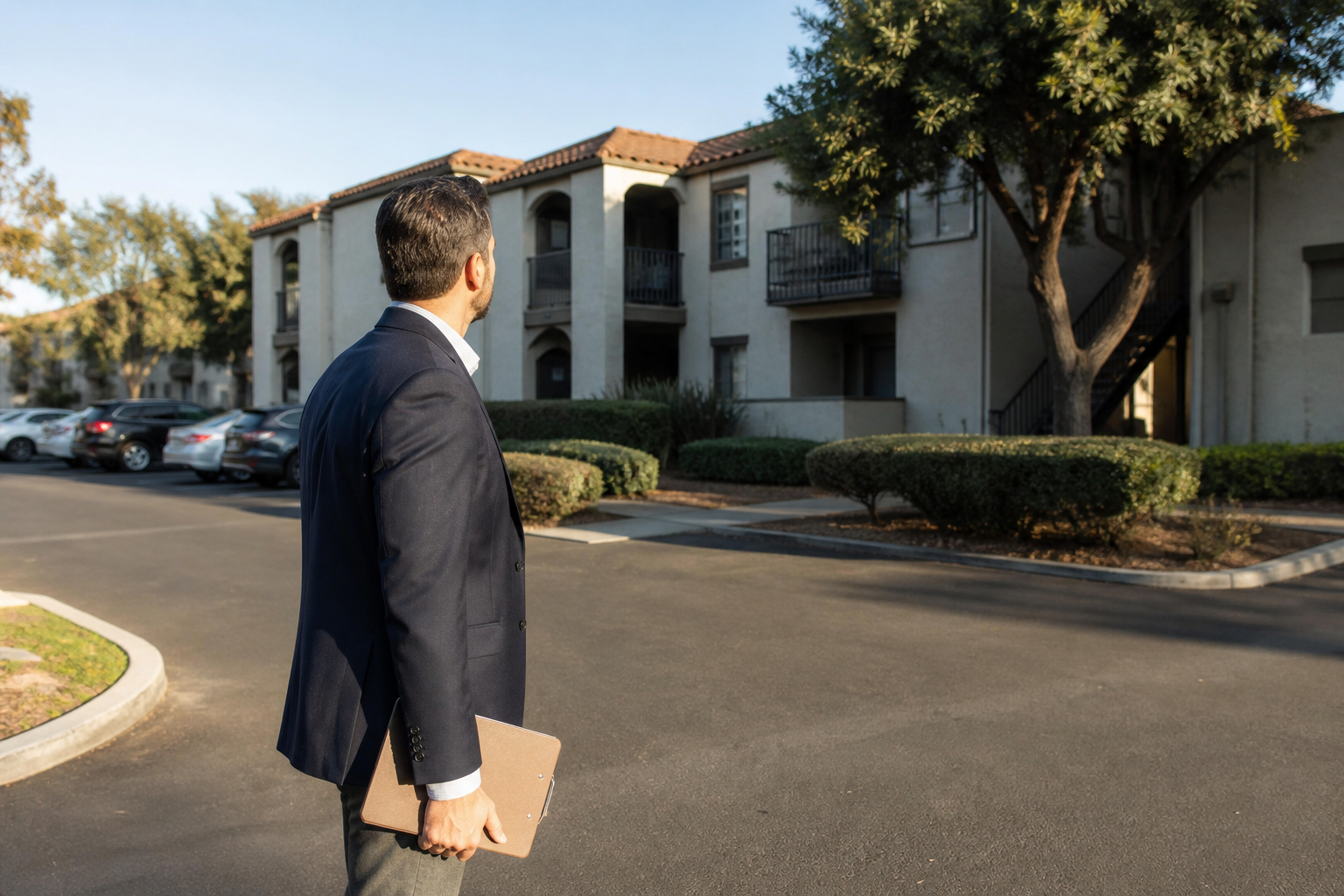
If you own a 5-50 unit apartment building in Orange County, relying on generic cap rates or outdated Broker Opinions of Value (BOV) is costing you real equity. In 2026, valuing multifamily real estate across Coastal, Central, and North Orange County requires analyzing true net operating income (NOI) stability, loss-to-lease velocity, debt coverage parameters, and active private off-market buyer appetite.
The Shift in Orange County Apartment Valuations
The Southern California commercial real estate landscape has fundamentally transformed. Traditional rule-of-thumb valuation metrics like Gross Rent Multiplier (GRM) are officially obsolete. Just a few years ago, an owner in Costa Mesa or Anaheim could multiply current gross rental income by 14 or 15 and arrive at a market price. Today, institutional private capital, syndicators, and family offices evaluate properties through a far more rigorous, underwriting-heavy framework.
With debt financing costs remaining higher than the record-low rates of 2021, commercial buyers can no longer afford to pay for theoretical upside or unearned pro-forma estimates. Accurate multifamily property valuation in Orange County now hinges on proving actual cash flow durability, expense containment, legislative compliance, and physical asset integrity.
4 Critical Pillars Driving OC Multifamily Valuation Today
In-Place Net Operating Income (NOI) vs. Pro Forma Fantasies
Commercial real estate brokers frequently draft marketing proposals based on optimistic ‘pro-forma’ rents, assuming every apartment can be renovated immediately and rented for an additional $400/month. Qualified buyers, however, underwrite actual trailing 12-month (T12) collections and verified loss-to-lease gaps. If your property suffers from high tenant turnover or uncollected utility reimbursements (RUBS), buyers will apply a higher capitalization rate to compensate for that operational risk.
Submarket Micro-Cap Rates Across Orange County
Orange County is not a single homogenous real estate market. Capital pricing varies significantly across submarket micro-climates:
- Coastal Orange County (Newport Beach, Huntington Beach, Laguna Beach): Cap rates remain compressed between 4.25%-4.75% due to extreme supply barriers, high land costs, and institutional capital preservation demands.
- Central Orange County (Irvine, Costa Mesa, Tustin): Cap rates range from 4.75%-5.25%, driven by strong white-collar job growth, young professional demographic expansion, and premium tenant retention.
- North Orange County (Anaheim, Fullerton, Santa Ana, Orange): Cap rates sit between 5.25%-5.75%, offering higher initial cash yields but requiring active asset management, hands-on oversight, and diligent maintenance budgeting.
Legislative Compliance and AB 1482 Loss-to-Lease Dynamics
California’s Tenant Protection Act (AB 1482) caps annual rent increases at 5% plus local CPI (up to a 10% maximum). Under-market rents present both an upside opportunity and a short-term valuation penalty. If your 12-unit building in Santa Ana is operating 30% below market rents, a new buyer cannot simply raise rents overnight. Underwriters adjust property valuation down to reflect the multi-year timeline required to legally bring leases to current market rates.
Capital Expenditure (CapEx) & Seismic/Utility Retrofit Discounts
Much of Orange County’s 5-50 unit housing stock was built between 1960 and 1980. Buyers rigorously audit roof lifespans, plumbing infrastructure (galvanized steel vs. copper or PEX), soft-story seismic retrofit compliance, and electrical panel capacities. Unaddressed deferred maintenance triggers direct dollar-for-dollar valuation discounts during purchase agreement negotiations.
Key Valuation Metrics Every OC Apartment Owner Should Track
To understand what your building would command in today’s environment, monitor these four primary underwriting metrics:
- Capitalization Rate (Cap Rate): Net Operating Income divided by Purchase Price. Indicates current yield before debt service.
- Debt Service Coverage Ratio (DSCR): NOI divided by annual debt service. Commercial lenders typically require a minimum 1.20x to 1.25x DSCR for 5-50 unit acquisition loans.
- Expense Ratio: Total operating expenses as a percentage of gross income. Healthy OC buildings typically operate between 35%-45% expense ratios depending on who pays utilities.
- Price Per Unit & Price Per Square Foot: Secondary benchmark metrics used to cross-reference comparable sales within a 1-mile radius over the preceding 6-12 months.
Why Off-Market Valuations Outperform Public Listings
When apartment owners decide to evaluate disposition strategies, their traditional instinct is to solicit on-market listing proposals from commercial brokerages. However, public listings carry notable disadvantages: public tenant unrest, marketing noise, and buyer re-trading during escrow.
Partnering directly with established private investment firms through an off-market valuation structure provides distinct advantages:
- Execution Certainty: Direct private buyers evaluate your property as principal investors using internal capital, eliminating speculative buyer chains.
- Absolute Confidentiality: Tenants, property management staff, and neighborhood competitors remain unaware that the building is being evaluated or sold.
- Full Equity Preservation: Direct off-market sales eliminate standard 4%-6% broker commissions, leaving hundreds of thousands of dollars in additional net proceeds for the owner.
How VisionWise Capital Approaches Property Valuations
VisionWise Capital, founded and led by CEO Sanford Coggins, specializes in acquiring, repositioning, and managing 5-50 unit multifamily assets across Southern California. Our marketing and valuation team, led by Marketing Director Winston Coggins, analyzes property values using real-time closed transactional data, localized submarket rent rolls, and proprietary debt structuring models.
We deliver Orange County property owners a comprehensive, line-by-line valuation breakdown detailing current asset value, potential 1031 exchange replacement vehicles, and immediate cash offer scenarios.
FAQs
What should readers verify before making a decision?
Verify current property, financial, legal, tax, financing, insurance, operating, and market information with qualified professionals.
Are projected investment results guaranteed?
No. Projections are based on assumptions, and actual income, expenses, values, financing terms, timing, and returns may differ.
Why is due diligence important?
Due diligence helps identify missing information, test assumptions, clarify responsibilities, and evaluate risks before a binding decision.
Which professionals may be needed?
Depending on the situation, consult qualified legal, tax, financial, lending, insurance, inspection, valuation, and property-management professionals.
Can market conditions change the outcome?
Yes. Interest rates, rents, occupancy, expenses, regulations, insurance, capital needs, and buyer or investor demand can change.
Is this article legal, tax, financial, or investment advice?
No. The article is provided for general educational purposes and does not replace advice based on individual circumstances.
For independent rent benchmarks by area, see HUD Fair Market Rents.
Related Reading
- Apartment Houses for Sale in Southern California: What the Neighborhood Tells You
- How to Sell a Multifamily Property Off-Market in SoCal Without a Broker
- Why Southern California Multifamily Matters to VisionWise Capital
Explore VisionWise Capital