
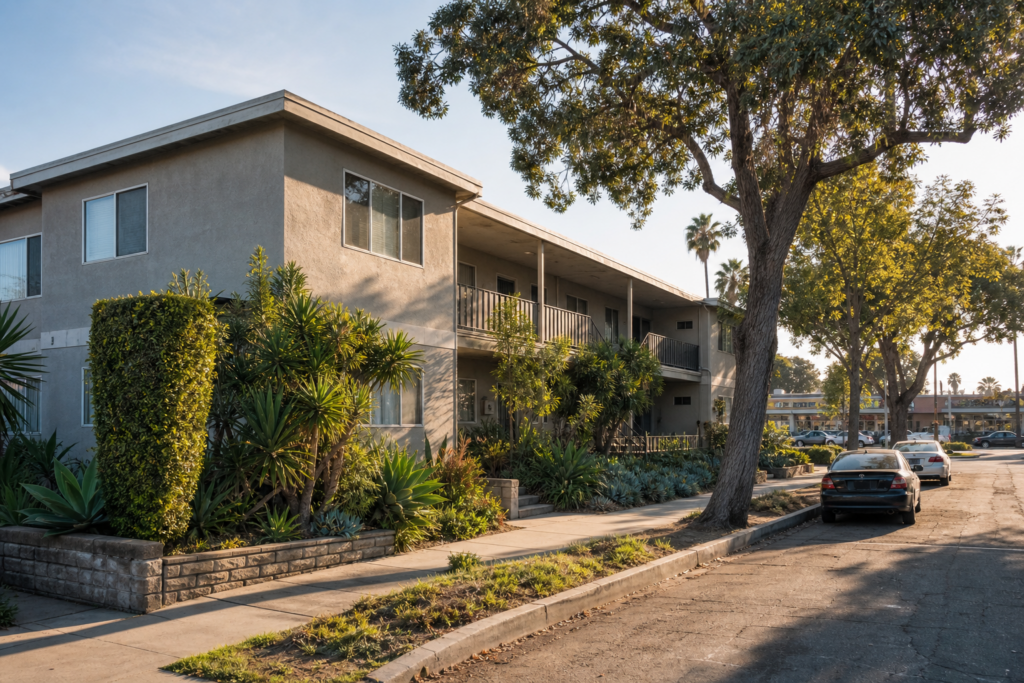
The proforma describes what the building can do. The neighborhood tells you whether to believe it.
When evaluating apartment houses for sale in Southern California, buyers typically focus first on cap rate, gross rent multiplier, and expense ratios. Those numbers matter. But they are built on assumptions about rent levels, occupancy, and tenant quality that are entirely dependent on the specific submarket the building sits in. The neighborhood context is not soft analysis. It is the foundation on which every financial projection rests.
Rental Demand Indicators Worth Walking
Before you trust a broker’s rent comparables, walk the block. Look for:
For-rent signs and vacancy patterns. A street with multiple “For Rent” signs suggests softening demand or an oversupply of units relative to renter demand. A building that has maintained 95%+ occupancy for two years deserves credit; understand why by looking at what surrounds it.
Retail and services activity. Neighborhoods with strong walkable retail, coffee shops, grocery access, and transit proximity attract renters with options. Those renters pay on time and stay longer. Neighborhoods losing retail signal demographic shifts worth understanding before you buy.
Employment proximity. SoCal multifamily performs strongest in submarkets with diverse, stable employment bases. Healthcare corridors, university adjacency, and mixed-use commercial districts all support rent stability. Single-employer towns carry concentration risk.
Reading the Building vs. Reading the Block
A well-maintained building on a declining block is a different investment than a value-add building in a transitioning neighborhood. Both can work. But they require different underwriting assumptions, different hold strategies, and different risk tolerances.
In Southern California, submarket transitions happen at the neighborhood level, not the city level. A 12-unit building two blocks from a major redevelopment zone in Long Beach is not the same investment as a similar building three miles away. Understanding where you are on the transition curve requires local knowledge, not just market-level data.
What the Tenant Profile Tells You
Request a rent roll that shows unit-level rents and move-in dates. Long-tenancy units under rent control are often well below market. That gap between current rent and market rent is either value-add opportunity (if the tenancy can turn over) or a permanent discount (if tenants are long-term and protected).
Understanding the realistic pace of rent recovery in your target submarket requires knowing local turnover rates, comparable rents at stabilized buildings, and how aggressively competing properties are absorbing new renters. Your property manager or a local broker active in that ZIP code is the right source for this data.
Off-Market Neighborhood Intelligence
The most valuable neighborhood intelligence is not on Zillow. It comes from conversations with local property managers, tenants, and owners in the same submarket. VisionWise Capital maintains direct relationships with apartment owners throughout Southern California and uses that network to evaluate neighborhood dynamics before any acquisition.
If you are evaluating apartment houses for sale in Southern California and want a second opinion on a specific submarket, we are a useful conversation.
Ready to take the next step? Schedule a Submarket Consultation →
This content is for informational purposes only and does not constitute investment, legal, or tax advice. Real estate transactions and private placements involve significant risk, including potential loss of principal. Always consult qualified legal, financial, and tax professionals before making investment decisions.
FAQs
What should readers verify before making a decision?
Verify current property, financial, legal, tax, financing, insurance, operating, and market information with qualified professionals.
Are projected investment results guaranteed?
No. Projections are based on assumptions, and actual income, expenses, values, financing terms, timing, and returns may differ.
Why is due diligence important?
Due diligence helps identify missing information, test assumptions, clarify responsibilities, and evaluate risks before a binding decision.
Which professionals may be needed?
Depending on the situation, consult qualified legal, tax, financial, lending, insurance, inspection, valuation, and property-management professionals.
Can market conditions change the outcome?
Yes. Interest rates, rents, occupancy, expenses, regulations, insurance, capital needs, and buyer or investor demand can change.
Is this article legal, tax, financial, or investment advice?
No. The article is provided for general educational purposes and does not replace advice based on individual circumstances.
To discuss whether private multifamily real estate fits your goals, contact VisionWise Capital.
For independent housing-stock and neighborhood data, see the U.S. Census American Housing Survey.
Related Reading
- What Off-Market Multifamily Buyers Want From SoCal Apartment Owners
- How to Sell a Multifamily Property Off-Market in SoCal Without a Broker
- Why Southern California Multifamily Matters to VisionWise Capital