
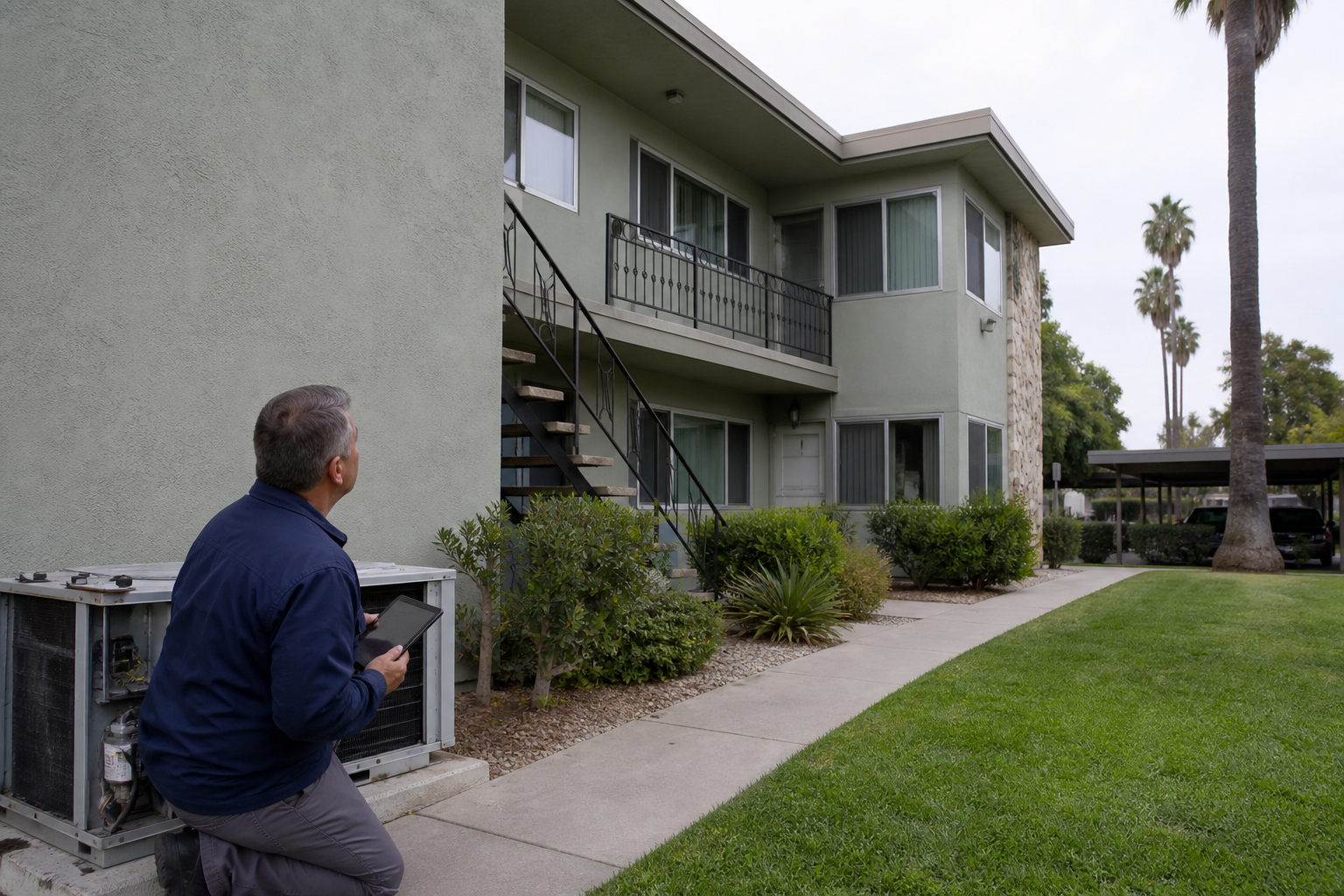
If you own an apartment building in Southern California, 2026 is a year that demands a clear-eyed look at what your asset is actually worth. Interest rate movements, rent growth normalization, new supply dynamics, and shifting investor sentiment have all converged to create a valuation environment that is more nuanced than it has been in years.
This is not a market where you can rely on 2022 or 2023 comps and assume your number is still accurate. Valuations have moved, in some cases significantly, and the direction depends heavily on submarket, unit mix, and the specific operating profile of your building.
Here is what every SoCal apartment owner needs to understand about multifamily valuations in 2026.
How Multifamily Buildings Are Valued
Unlike single-family homes, which are valued primarily through comparable sales, commercial apartment buildings are valued based on income. Specifically, the income capitalization approach drives valuation for virtually all multifamily assets in SoCal.
The formula is straightforward:
Value = Net Operating Income (NOI) / Cap Rate
NOI is your total rental income minus all operating expenses (property management, maintenance, insurance, property taxes, utilities, landscaping, but not debt service). Cap rate is the prevailing market rate of return buyers expect for assets similar to yours.
The implication: a 50 basis point movement in cap rates has an outsized impact on value. A building generating $200,000 in NOI is worth $4,000,000 at a 5.0% cap rate, and only $3,636,000 at a 5.5% cap rate. That is a $364,000 swing on cap rate movement alone, before any change in the income itself.
Where SoCal Cap Rates Stand in 2026
Cap rates across Southern California have modestly expanded from their 2021-2022 lows, reflecting higher cost of capital in a post-rate-hike environment. However, the expansion has been uneven.
Los Angeles (City and County)
Stabilized Class B/C assets in the city core are trading in the 4.5-5.25% cap rate range in 2026. Rent-controlled buildings under AB 1482 in high-demand neighborhoods (Silver Lake, Echo Park, Koreatown, Culver City) continue to attract compressed pricing from buyers who underwrite long-term rent growth. Value-add plays with below-market rents can still command premium pricing relative to current NOI.
Orange County
OC multifamily remains among the tightest markets in the country for sub-50-unit assets. Anaheim, Santa Ana, and Garden Grove submarkets are trading in the 4.75-5.5% range. The Irvine and coastal submarkets continue to see institutional and family office interest, often at sub-5% cap rates for stabilized product.
Inland Empire
The IE has seen more cap rate expansion than coastal markets, reflecting higher interest rate sensitivity among its buyer pool. Riverside and San Bernardino County assets are generally trading at 5.5-6.5% caps for stabilized assets. However, strong rent growth fundamentals, driven by affordability migration from LA and OC, continue to support buyer demand.
The Impact of Rent Control on Valuation
California's AB 1482 (the Tenant Protection Act) and local rent control ordinances are a meaningful valuation variable that many owners underestimate. For buildings covered under rent stabilization:
Annual rent increases are capped (typically 5% plus CPI, with a 10% maximum under AB 1482)
Forced vacancy decontrol means turnover is the primary mechanism for capturing market rents
Long-tenured buildings with low turnover may be significantly below market rent, which paradoxically creates value-add opportunity for the right buyer
If your building has below-market rents due to long-term tenancies, your NOI may understate the asset's true potential. A sophisticated buyer will underwrite to a pro forma that factors in turnover-driven rent normalization. That gap between in-place NOI and market NOI is often where negotiation happens.
What Affects Your Building's Value Today
Beyond cap rates and NOI, several property-specific factors are influencing multifamily valuations in SoCal in 2026:
Unit Mix
Two-bedroom and three-bedroom units are commanding stronger per-unit valuations than studios and one-bedrooms in most submarkets, reflecting post-pandemic household size preferences and remote work dynamics.
Deferred Maintenance
Buyers are pricing deferred maintenance more aggressively in 2026 than in prior years. A building with an aging roof, plumbing issues, or outdated electrical panels will see those items reflected in either price reductions or contingency requests during due diligence. Addressing high-priority items before going to market, or understanding their pricing impact, is important.
Assumable Debt
If your building carries an existing below-market rate loan that a buyer can assume, that is a meaningful value-add. In a 6-7% interest rate environment, an assumable 3.5% Freddie Mac or Fannie Mae loan can add hundreds of thousands of dollars to what a buyer will pay.
Seismic and Soft Story Compliance
Buildings subject to LA's Soft Story Retrofit Ordinance that have not yet completed compliance work face a known future capital expenditure that buyers will quantify and price in. If your building is on the retrofit list, know the estimated cost and timeline before entering any sale conversation.
How to Get an Accurate Valuation on Your Building
There are three practical ways to establish an accurate current value:
Certified MAI appraisal: The most defensible number for legal, tax, or estate purposes. Typically costs $3,000-$6,000 and takes 2-4 weeks.
Broker Opinion of Value (BOV): A commercial broker can provide a market-range estimate based on recent comps at no charge, though their incentive is to land the listing, which can introduce upward bias.
Direct buyer feedback: Engaging a qualified operator or acquisition firm for a preliminary conversation gives you a real-world data point on what a serious buyer would pay today. No obligation, no marketing period, no commission.
For most owners who are considering a sale in the next 12-24 months, the third option, a direct conversation with an active buyer, is the most efficient first step. It costs nothing, takes 30 minutes, and gives you a current market reality check before you commit to any process.
2026 Valuation Outlook for SoCal Multifamily
The near-term valuation environment in Southern California multifamily is characterized by selectivity. Well-located, well-maintained assets in supply-constrained submarkets continue to attract strong buyer demand. Operationally challenged assets, high deferred maintenance, rent rolls significantly below market, or complex tenant situations, are seeing wider bid-ask spreads.
New supply in SoCal remains constrained relative to historical norms, which continues to support rent growth fundamentals. That underlying demand driver is a floor under valuations even as financing costs remain elevated.
The owners who will transact at favorable prices in 2026 are those who:
- Have their financials organized and diligence-ready
- Understand their building's true market value, not its last assessed value
- Identify qualified buyers before formally committing to a sales process
- Are flexible on timing and structure to attract the most competitive offers
Get a Direct Read on What Your Building Is Worth
VisionWise Capital acquires multifamily properties directly from owners across Los Angeles, Orange County, and the Inland Empire. If you want a straightforward, no-obligation read on what your building would trade for in today's market, we can have that conversation in 30 minutes.
No broker. No listing agreement. No obligation.
Schedule a free consultation →
FAQs
What should readers verify before making a decision?
Verify current property, financial, legal, tax, financing, insurance, operating, and market information with qualified professionals.
Are projected investment results guaranteed?
No. Projections are based on assumptions, and actual income, expenses, values, financing terms, timing, and returns may differ.
Why is due diligence important?
Due diligence helps identify missing information, test assumptions, clarify responsibilities, and evaluate risks before a binding decision.
Which professionals may be needed?
Depending on the situation, consult qualified legal, tax, financial, lending, insurance, inspection, valuation, and property-management professionals.
Can market conditions change the outcome?
Yes. Interest rates, rents, occupancy, expenses, regulations, insurance, capital needs, and buyer or investor demand can change.
Is this article legal, tax, financial, or investment advice?
No. The article is provided for general educational purposes and does not replace advice based on individual circumstances.
For independent multifamily lending research, see Freddie Mac Multifamily research.
Related Reading
- What Is Reg D Rule 506(c)? A Plain-English Overview
- What Off-Market Multifamily Buyers Want From SoCal Apartment Owners in 2026
- Multifamily Property Valuation Orange County: What Your Apartment Building Is Actually Worth in 2026