
Eight painted parking spaces make a tempting income calculation. But how many support an additional charge? Count only revenue tied to usable spaces, supported agreements and reconciled collections. In the hypothetical building below, two separate agreements produce $225 of monthly receipts after a credit, far below a projection that prices all eight spaces.
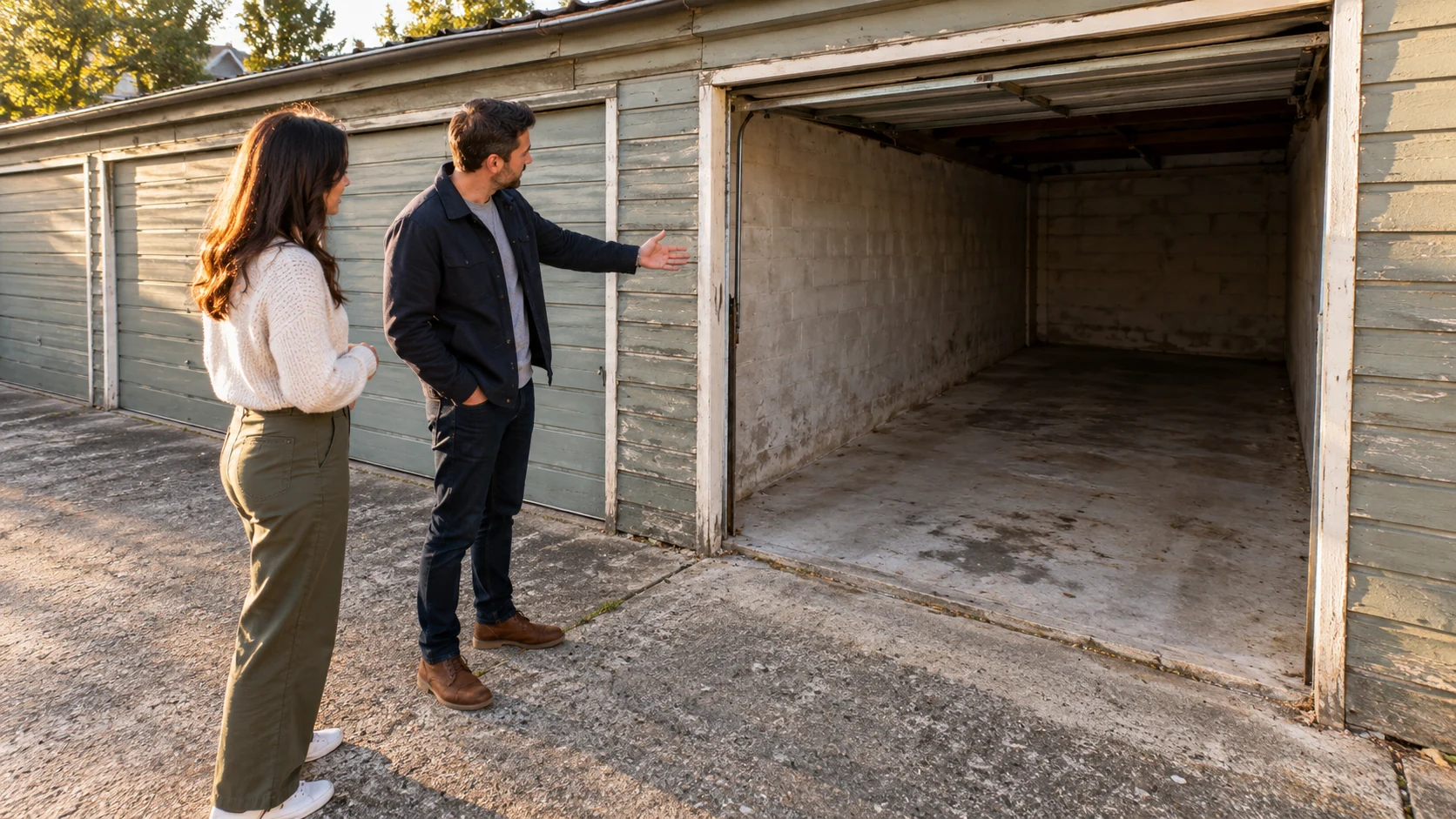
For accredited investors evaluating a small Southern California apartment building, this is where a modest income assumption can quietly grow into an unsupported one. The seller’s multiplication is easy to follow. The harder work is finding which spaces are already included in rent, which cannot be rented separately and which users actually pay.
Give each of the eight spaces a documented use
Request a current plan identifying each stall, garage, carport and tandem arrangement. Give every location a consistent label. Then compare that plan with leases, parking addenda, management records and a site visit. Different numbering systems should be reconciled before they become different income assumptions.
A tandem pair needs particular care. Two painted rectangles do not necessarily represent two independently usable spaces. Ask who controls access, whether the spaces serve one household and how the agreement describes them. A garage used for storage also should not silently become a vehicle-parking rental in the acquisition forecast.
Mark the eight spaces by actual use before assigning any new revenue. Four in the example are already included in apartment leases, and another serves an operational purpose. Have qualified local reviewers address access, required or accessible parking and other restrictions. A parking map organizes the evidence; it grants no authority to change a resident’s arrangement.
The broader rent-roll reconciliation process checks apartment income against underlying records. For parking, add a physical location to each agreement so the same space cannot support two charges or an occupied stall appear as unused capacity.
Separate included parking from separately billed parking
A lease may include one space in the apartment rent. Another resident may pay separately for a second space. Both arrangements produce occupied parking, but only the second creates an additional charge. Adding a market parking allowance to both would overstate income.
Review amendments and concessions as well as the original lease. A temporary waiver, a garage credit or an agreement made during a repair can affect collections. Ask management to identify verbal arrangements requiring clarification rather than assuming the absence of a signed addendum means no commitment exists.
For nonresident users, establish the agreement’s term, access conditions and termination provisions. A neighboring business renting several spaces under one agreement creates a different concentration of revenue from individual residents renting independently. Neither arrangement is inherently better; the assumptions should describe the actual customer and the owner’s obligations.
The California Attorney General’s landlord-tenant guidance explains why leases, tenant protections and local rules matter to property operations. It does not establish that a particular parking charge can be introduced or increased. Obtain advice on the actual arrangement before modeling a change to an existing tenancy.
Follow the charge through to collection
Request a monthly parking schedule showing the space, agreement, billed amount, credits, payments and unpaid balance. Reconcile its total to the accounting ledger. Where apartment rent and parking arrive in one payment, confirm the allocation method so the receipt is counted once.
A deposit is not recurring parking revenue. Neither is a payment for a remote control automatically a monthly charge. Separate deposits, replacement-device charges, late payments and other nonrecurring items from the income being projected into the next ownership period.
Compare several months. A year-end balance can hide a recurring collection problem, while a single late receipt can make an otherwise reliable arrangement look weak. Keep the service period and receipt date distinct. Cash collected this month for last month’s parking should not support two months of income.
The two separate agreements still need a clear payment allocation. If management cannot distinguish their receipts from apartment rent, acknowledge that limit rather than adding an unsupported parking line. Review the combined income stream until the ledger can show what was billed, credited and paid without counting one resident payment twice.
From eight spaces to two additional charges
Assume a property has eight individually usable parking spaces. Four are included in apartment leases, two have separate agreements charging $125 per month, one is vacant and one is reserved for an operational use. These are invented figures for the calculation, not a VWC property or a local pricing estimate.
The supported additional monthly charge is $250 for the two separately rented spaces. Suppose the ledger records a $25 credit and $225 of receipts for the same month. The additional cash collected is $225. It is not $1,000, which would result from pricing all eight spaces at $125, or $375, which would also count the vacant space before it is rented.
If the same $225 collection occurred in each of twelve months, annual receipts would be $2,700. That annualization is a scenario, not evidence that the next twelve months will repeat. Review agreement expirations, changes in users, collection history and expenses before carrying it into the model.
The vacant eighth-space opportunity belongs in a separate upside case after availability, demand, legal use and leasing cost are reviewed. It is the first place to look for improvement, not a reason to raise the current $225 receipt figure. Describe the evidence and operating step that would move it into the supported base case.
Calculate the contribution after the relevant costs
Parking revenue can carry costs: gate service, access equipment, lighting, markings, administration and collection charges. Some expenses serve the whole property. Others arise specifically because parking is separately rented. Ask the accountant and manager how those costs are allocated and avoid deducting the same expense twice.
Distinguish routine expense from periodic capital work. A driveway replacement may belong in the capital plan rather than the recurring operating line, but the property still needs cash for it. Extra parking income does not make that obligation disappear.
Changes to access or circulation can also interact with title rights, neighboring property use and building approvals. The multifamily due-diligence checklist provides the broader review context. A parking calculation should refer unresolved questions to the relevant professional rather than treating physical availability as sufficient evidence.
Now test the two paying users rather than all eight painted spaces. If one stops paying or a repair temporarily blocks access, which receipts disappear and which gate, lighting or administrative costs continue? A small base of separately billed spaces can make one interruption significant to this income line even when the broader property remains occupied.
Questions before accepting the income line
- Can every separately billed charge be matched to one space and one current agreement?
- Which spaces are already included in apartment rent, and where is that documented?
- Do credits and cash receipts reconcile without counting apartment payments twice?
- Which proposed charges depend on a future legal, leasing or physical change?
- What costs or interrupted access could reduce the expected contribution?
Warning signs include a parking total based solely on painted stalls, an income projection that assumes every resident will accept a new fee, and a ledger that mixes deposits with recurring collections. These are questions to resolve, not proof of intentional misstatement.
The review ends with an intentionally narrower conclusion than the opening multiplication: $250 billed and $225 collected under the illustration’s two agreements, before relevant expenses. The remaining spaces have distinct uses and conditions. That is a defensible starting point for evaluating parking improvements without pricing tomorrow’s possibility as today’s income. Learn more about the VisionWise investment process.
Important information
Past performance is no guarantee of future results. All investments involve risk and may result in loss. This material is for informational purposes only and does not constitute an offer to sell securities or a solicitation of an offer to buy securities.